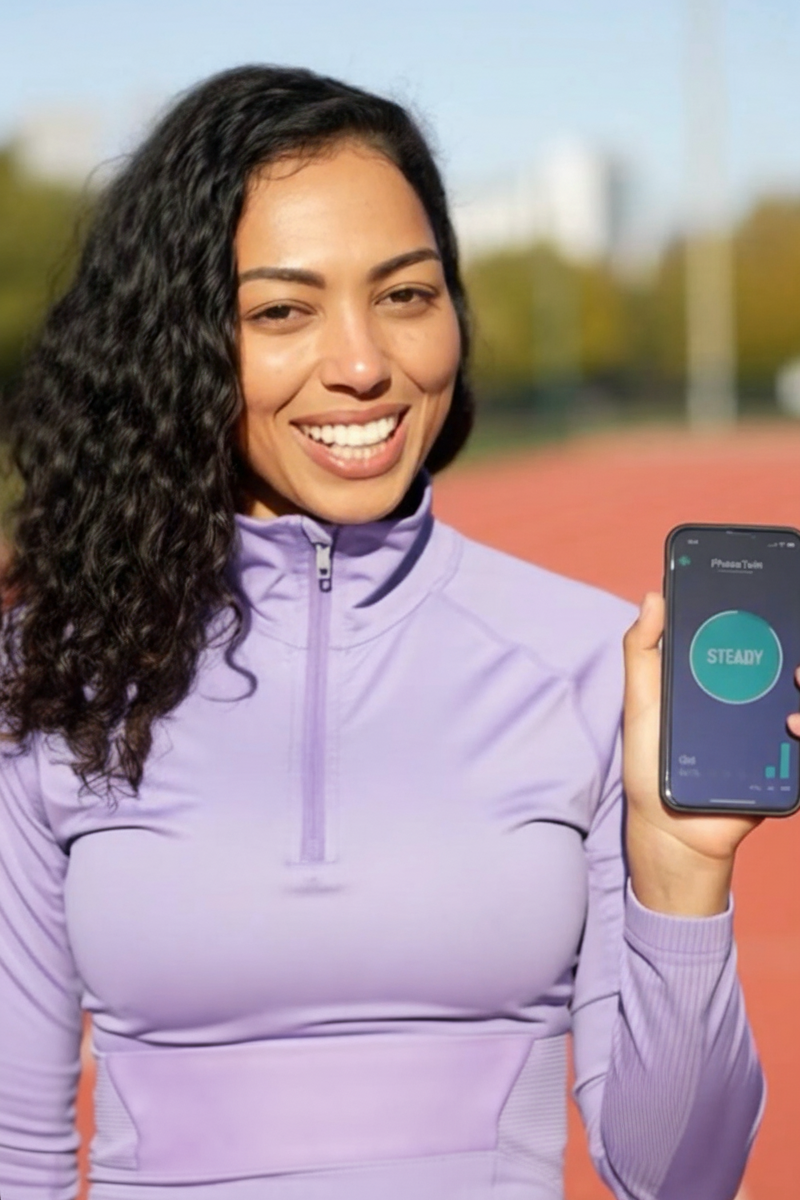
PhaseTwin
Smarter training days for women
Daily training call: Push · Steady · Recover
Coach-simple. On-device. No new hardware.
Smarter training days for women
Daily training call: Push · Steady · Recover
Coach-simple. On-device. No new hardware.
12-minute morning check — balance, finger taps, 5× sit-to-stand, quick HRV.
Works with or without a wearable — rolling baseline if you don't use one.
Cycle-aware — adjusts for phase so the call is fair and consistent.
No. Wearables help but are optional. The 12-minute check plus phase-aware baselines are enough to produce a daily call.
Seated→standing HRV (if available), single-leg balance, 30-second finger taps (both hands), 5× sit-to-stand, soreness, readiness.
A morning list with Push/Steady/Recover per athlete and a weekly 1-pager. No dashboards.
Wellness-only. Private by default. We share today's call and weekly aggregates with staff. Athletes can withdraw anytime.
We compare each athlete to her rolling, phase-aware baseline to avoid late-luteal false 'under-recovered' flags common in generic algorithms.
Adriana Tavarez is a Mount Holyoke College student and United States Air Force service member building PhaseTwin to solve a problem she knows firsthand: training readiness tools that ignore women's physiology. As an active woman balancing military service and academic excellence, she's experienced how generic algorithms flag late-luteal phase changes as "under-recovery"—when nothing is wrong.
PhaseTwin combines neuromotor checks with phase-aware baselines to give coaches accurate Push/Steady/Recover calls that actually work for female athletes. Pilot programs aim to reduce injury rates and improve performance by making training readiness tools designed for women, not retrofitted from men's data.
Questions about the pilot?
📍 Piloting at Mount Holyoke College
South Hadley, MA